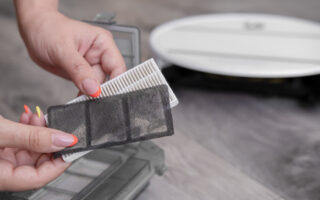
HEPA is a top standard for filtration.
Not every “HEPA filter” on a spec sheet performs the same way. When you’re shopping for an air purifier with a HEPA filter, the grade it uses — anywhere from a basic HEPA barrier up to ULPA — determines exactly how small a particle it can catch, and that matters more than most buyers realize.
What Is a HEPA Filter, and Where Did the Standard Come From?
HEPA stands for High Efficiency Particulate Air. The technology traces back to the 1940s, when U.S. government researchers working on the nuclear program needed a way to filter radioactive dust from the air — what eventually became the Atomic Energy Commission helped develop and standardize it. Today, the U.S. EPA defines a HEPA filter as one that can theoretically capture at least 99.97% of particles at 0.3 microns — a size chosen because it’s the hardest for any filter to catch, not because it’s the only size that matters. Particles larger or smaller than 0.3 microns are actually trapped with even higher efficiency.
In practice, that means a true HEPA filter is capturing far more than just that one particle size — mold spores, dust mite debris, bacteria, and pollen all fall well within its range.
Real testing backs that up. NASA’s 2016 study on HEPA-rated filtration media found that HEPA filters capture the smallest particles through a mechanism called diffusion — tiny particles get knocked into filter fibers by random molecular collisions rather than simply being too large to pass through. That’s why HEPA media performed well even against nanoparticles as small as 0.01 microns in NASA’s testing, well below the 0.3-micron size used to set the HEPA standard. (Read the full NASA technical report.)
Five Grades of HEPA Filtration, Ranked
Not every filter marketed with “HEPA” in the name performs the same, and the gap between the weakest and strongest options is bigger than most buyers expect. From lowest to strongest:
- HEPA barrier. Not true HEPA at all — a filter cloth rated at 95% efficiency down to 1 micron. It shows up on units built for heavy chemical or VOC abatement, where the design puts its capacity into carbon rather than fine-particle filtration. (More on this in Shopping Considerations below.)
- Standard HEPA, also called medical-grade HEPA. The true HEPA baseline: captures 99.97% of particles at 0.3 microns. This is what most people mean by “HEPA filter,” and it’s sufficient for the vast majority of homes dealing with dust, pollen, pet dander, and general allergens.
- Super HEPA, like the H14-rated filters used in Airpura’s SG714 and SG414 models, is certified to the European EN 1822 standard’s H14 class — a minimum of 99.995% efficiency at the Most Penetrating Particle Size (MPPS), the specific particle size that’s hardest for that filter to catch. MPPS typically falls in the 0.1–0.2 micron range, tighter than the fixed 0.3-micron reference the U.S. standard tests against — part of why Super HEPA outperforms standard HEPA on both the percentage and the difficulty of the test itself.
- ULPA. The tightest of the group, rated to 99.999% efficiency down to 0.1–0.12 microns. It comes with a real airflow trade-off — more on that below.
For most households, standard/medical-grade HEPA covers the job. Super HEPA earns its place for a specific medical sensitivity or an unusually fine-particle problem. ULPA is rarely the right call for a home — more on why in the next section.
Beyond HEPA: The ULPA Trade-Off
ULPA stands for Ultra-Low Penetration Air, and it’s the tightest filtration standard on the market — but that extra performance comes with a real cost, which is why it’s the least common choice for home air purifiers.
NASA’s testing on HEPA-rated media found that cutting the airflow velocity through a filter can boost a standard HEPA filter’s efficiency enough to match or beat ULPA-level performance, since slower-moving air gives particles more time to be captured against the fibers. That’s part of why ULPA media reaches such high efficiency to begin with — it’s engineered with tighter media, which has a similar effect to slowing the airflow down. In practice, that same tight media also resists airflow more than a HEPA filter does, and in some units that shows up as a noticeably lower air output (CFM) for a given fan and housing size.
For most homes, that trade-off isn’t worth it: the airflow penalty is significant, and the filtration gain over Super HEPA is marginal for typical household air quality concerns. That’s also why ULPA units aren’t part of our standard catalog — they’re a special-order item through certain suppliers rather than a stocked option, reflecting how rarely they’re the right fit outside cleanroom-style applications where maximum capture matters more than air volume.
Why a Loaded HEPA Filter Can Catch Even Finer Particles
There’s a separate factor worth knowing about, distinct from the NASA diffusion research above: how a filter performs as it accumulates dust. As a HEPA filter collects particles, that buildup — sometimes called a dust cake — becomes part of the filtration itself, narrowing the gaps between fibers and giving incoming particles even less room to pass through. This is a well-documented effect in general filtration science, separate from NASA’s clean-media testing: loaded filter media generally captures fine particles more effectively than the same filter did fresh out of the box.
Standard and Super HEPA media differ largely in how tightly the fibers are packed from the start, which is why Super HEPA outperforms standard HEPA on the smallest particles right out of the box — but a standard HEPA filter does close some of that gap as it loads.
That improvement isn’t free. The same buildup that strengthens capture also restricts airflow, so a heavily loaded filter ends up moving less air overall even as it filters what does get through more thoroughly. That’s a real reason filter replacement schedules matter — not because the filter has gotten worse at catching particles, but because reduced airflow means less total air getting cleaned per hour.
Why HEPA Filtration Matters
People typically turn to HEPA filtration to solve a specific problem, not just for general peace of mind.
Allergies and asthma. Airborne particles that trigger allergic reactions — runny nose, itchy or watery eyes, coughing, sneezing, or a full asthma flare — are exactly the size range HEPA filters are built to capture.
Mold sensitivity. Mold spores generally run 2 to 10 microns, well within HEPA’s capture range, so a HEPA filter helps reduce spore counts in the air and lowers exposure for anyone in the home who reacts to them.
HEPA Filters and Wildfire Smoke
Wildfire smoke, wood smoke, and combustion byproducts all release ultrafine particles known as PM 2.5. These particles are small enough to get lodged deep in the lungs, where they can trigger or worsen:
- Coughing
- COPD
- Asthma or allergy flare-ups
- Trouble breathing
Reducing PM 2.5 exposure indoors means running an air purifier with true HEPA filtration. Units like the Amaircare 3000 HEPA use a true, medical-grade HEPA filter built to capture the fine particulates that come with wildfire smoke.
Wildfire smoke isn’t just particulates, though — it also carries VOCs, the gas-phase compounds behind that lingering smoke smell. Those pass straight through HEPA media untouched. HEPA handles the particulate side of wildfire smoke; pairing it with activated carbon is what addresses the smell and VOC side (more on that pairing below).
Shopping Considerations: HEPA Isn’t the Whole Story
A few things beyond the HEPA rating itself are worth checking before you buy:
True HEPA vs. “HEPA-type.” A true HEPA filter is independently rated to the 99.97% standard. “HEPA-type” or “HEPA-like” are marketing terms, not certifications — they aren’t held to the same tested efficiency. If a product page doesn’t specify “true HEPA” or “medical-grade HEPA,” it’s worth asking what standard the filter is actually rated to.
Don’t compare a HEPA barrier unit to a true HEPA unit on particle capture alone. As covered above, a HEPA barrier is a coarser filter cloth, not true HEPA — units that use one (like Airpura’s DLX line) are built to put their capacity into carbon for chemical and gas removal rather than fine-particle performance. That’s a legitimate design choice for chemical-heavy environments, but it’s a different job than a true HEPA filter is doing.
Pre-filters. A pre-filter captures larger particles — generally one micron and up — before air ever reaches the primary HEPA filter. That extends the HEPA filter’s usable life by keeping it from clogging with the bigger stuff.
Media and seal quality. A pleated design gives the filter more surface area to trap particles across, and a proper sealant around the filter housing keeps air from bypassing the media entirely — a gap here undercuts the filtration rating no matter how good the filter itself is.
Pairing with carbon. HEPA handles particles, but it doesn’t touch odors, gases, or VOCs. If off-gassing or chemical odors are a concern alongside particulates, pairing HEPA with activated carbon filtration covers both. Our guide to the best activated carbon air purifiers walks through units that combine the two well.
Filter life. Most HEPA filters last 2 to 5 years, but that range depends heavily on usage and air quality in your specific home — check your unit’s literature for the manufacturer’s recommended replacement schedule.
Placement matters too. Match the purifier’s coverage rating (in square feet) to the room, and think about whether it’s going in a bedroom, living room, or a busier shared space.
Frequently Asked Questions:
What percentage of particles does a HEPA filter capture? A standard (medical-grade) HEPA filter captures at least 99.97% of particles at 0.3 microns — a size chosen because it’s the hardest for a filter to trap, not because it’s the smallest particle involved. Super HEPA (EN 1822 class H14) raises that to 99.995% at the Most Penetrating Particle Size, typically 0.1–0.2 microns, and ULPA raises it further to 99.999% at 0.1–0.12 microns.
What are the different grades of HEPA filtration, from weakest to strongest? From lowest to strongest: HEPA barrier (95% at 1 micron — not true HEPA), standard/medical-grade HEPA (99.97% at 0.3 microns), Super HEPA (EN 1822 class H14, 99.995% at the Most Penetrating Particle Size, typically 0.1–0.2 microns), and ULPA (99.999% at 0.1–0.12 microns).
What’s the difference between HEPA and ULPA? ULPA (Ultra-Low Penetration Air) captures 99.999% of particles down to 0.1–0.12 microns, a tighter standard than any HEPA grade. That extra capture comes at the cost of airflow — ULPA media resists air movement more than HEPA media, which can mean lower total air output from the same size unit. Because of that trade-off, ULPA is rarely the best fit for home use and is typically a special-order item rather than a stocked one.
Is “HEPA-type” the same as a true HEPA filter? No. A true HEPA filter is independently rated to capture at least 99.97% of particles at 0.3 microns. “HEPA-type” and “HEPA-like” are marketing terms that aren’t held to that same tested standard, so it’s worth confirming a product specifies true or medical-grade HEPA.
What is a “HEPA barrier,” and is it the same as HEPA? No. A HEPA barrier is a filter cloth rated at 95% efficiency down to 1 micron — a coarser cut than the 99.97%-at-0.3-micron true HEPA standard. It shows up on units built for heavy chemical or VOC abatement, where the design prioritizes carbon capacity for gases over fine-particle capture.
Do HEPA filters help with wildfire smoke? Yes. Wildfire smoke contains ultrafine PM 2.5 particles that fall within a HEPA filter’s capture range, which helps reduce indoor exposure and can ease related symptoms like coughing or worsened asthma.
How often do HEPA filters need to be replaced? Filter life varies by unit and usage, but many HEPA filters last 2 to 5 years. Check the manufacturer literature for your specific model to confirm its recommended replacement schedule.
USAirPurifiers is a family and veteran-owned U.S. business offering a wide range of high-quality air purifiers, scrubbers, filters, air monitors and humidifiers. The Lulay Team knows that clean air isn’t one-size-fits-all, so we match the right solution to your needs and budget. Invest in your family’s health and breathe easier. Your health is truly our top priority because everyone deserves to enjoy clean air everywhere!