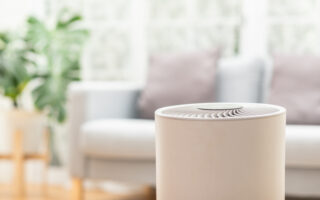
Air purifier in cozy white bed room for filter and cleaning removing dust PM2.5 HEPA in home,for fresh air and healthy life,Air Pollution Concept
If you’re researching the quality of the indoor air in your home, there’s a very important acronym you should know about.
It’s VOC.
What are VOCs?
VOCs are volatile organic compounds. They are carbon-based chemicals – they come from various types of building materials, furniture, and consumer products, as industrial chemicals that off-gas into the home. That’s because they easily get into the surrounding air. VOCs in home situations can mean subtle health risks that you may not know about.
VOCs come from products that are made with harsh chemicals.
You might think of VOCs as coming from paint or paint thinner, or other solvents.
But they are also present in things like cleaning products, appliances, or anything made with plastic, or even rugs or textiles.
They also come from building materials like carpet or laminate flooring. You can even find them in your car, where the upholstery and other materials off-gas these potentially harmful chemicals.
VOCs and Health Conditions
In the short term, people with exposure to VOCs can expect symptoms like eye, nose and throat irritation, as well as headaches, dizziness, nausea, or fatigue.
In the longer term, the chemicals can cause damage to the liver and kidneys, affect the central nervous system, and cause hormonal disruption. Some are also known to be carcinogens: for example, there’s benzene exposure, which doctors warn against. VOCs can also be triggers for asthma attacks.
High risk groups include children, people with asthma, and pets.
Solutions for VOCs
So what should you do to keep these kinds of chemicals out of your indoor air in your home?
This is where you live, and you should be worried about these chemicals infiltrating your space.
One thing you can do is to off-gas the products, like furniture or building materials, or appliances, somewhere else. But a lot of people don’t have that luxury. They don’t have a secondary indoor space that’s safe to keep things in while they do their off-gassing.
In addition, the off-gassing can last a long time. Practically speaking, it doesn’t last forever, but it can easily last a couple of years. Although the worst off-gassing happens early, these materials and products can continue to emit VOCs for months after they are installed or put into a home.
That leads to the air purifier as a solution.
Using an Air Purifier
If you run an air purifier at a sufficient level, one that’s rated for your indoor space, you can mitigate a lot of the effect of the VOCs by removing them from the air.
What to Use
The key here is to have the right technology. Many air purifiers primarily use something called a HEPA filter. This is a high-quality filter that works on particles down to around .3 or .1 microns.
This is great for particle-based air pollution, but it’s not great for VOCs. VOCs are not particles; they are chemicals in the form of gases.
What you need to mitigate VOCs is activated carbon.
Activated carbon is a material that can attract the gas molecules through a process called adsorption.
Having the right activated carbon bed can provide you with cleaner, healthier air in your home, if VOCs are an issue.
USAirPurifiers is a family and veteran-owned U.S. business offering a wide range of high-quality air purifiers, scrubbers, filters, air monitors and humidifiers. The Lulay Team knows that clean air isn’t one-size-fits-all, so we match the right solution to your needs and budget. Invest in your family’s health and breathe easier. Your health is truly our top priority because everyone deserves to enjoy clean air everywhere!