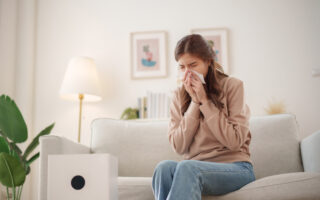
Young Asian woman sits on a couch, sneezing and holding a tissue to her nose while an air purifier operates nearby to improve air quality.
We know that allergies are a common problem in America. You can count it by the number of Americans diagnosed with particular allergies, for example, where a staggering 25% of Americans have seasonal allergies! Or you can look at Google searches for the term “allergies” to see that this kind of thing is really quite common.
Either way, many millions of households are trying to figure out how to deal with one type of allergy or another. A major category of allergies is what someone would call ‘environmental allergies,’ where they encounter allergens through the air.
Environmental Allergies versus Food Allergies
Environmental allergies have to do with the infiltration of contaminants into the body system through the air.
Food and medication allergies are different – they can happen when people digest a substance, and although both types of allergies can impact the bloodstream, digestion is different than breathing something in.
Within the broader category of environmental allergies, you have allergies to animals, like dogs and cats, allergies to plants. Pollen is usually the culprit here. You also have specific allergies to various chemicals or substances that people call “aerosolized,” or that float around in the air around you.
Environmental Allergies and Indoor Air
Environmental allergies are most usually worse indoors. That’s because the air in the spaces becomes trapped, and the contaminants don’t dissipate like they would outside.
To make things worse, modern homes and living spaces are increasingly sealed, in order to conserve energy and cost for heating and cooling. So the air really stays contained, and the contaminants continue to be a problem.
There’s a whole spectrum of environmental allergies, too – some people have very high sensitivity, and others don’t manifest symptoms unless they encounter a high volume of allergens.
Either way, there are certain remedies or mitigation actions you can take for reducing allergen exposure and allergic responses in your home.
One is ventilation. Another is cleaning, such as vacuuming with a HEPA grade vacuum. But there’s also the option of using an air purifier to cycle the indoor air and clean it continually. For many allergy sufferers, there’s really no other way to effectively keep air cleaner and safer to breathe.
HEPA Technologies
In explaining how air purifiers work to help allergy sufferers, we have to talk about how a HEPA filter works.
The HEPA filter traps particles, even ultra-fine particles such as but not limited to mold spores, pet dander, pollen, and dust mites, in a fine mesh. It decreases their counts from indoor air. The HEPA filter is particularly effective against items like pet dander, mold, spores, and various small particles and microbes that it can scrub out of your home’s air.
Scenarios for Allergies
We’ve seen shoppers trying to figure out which purifier is best. Figuring out cubic feet per meter or CFM, along with air changes per hour, or ACH, is useful.
Some customers have seen this work really well in choosing the best air purifiers for their needs.
Others are still engaged in the grim struggle to find creative solutions. We talked to one customer who had been hanging sheets in a hallway to try to segment the indoor air and avoid exposure that way.
“It didn’t work at all,” he said. “I had to get two purifiers running, and that finally did the trick.”
We also heard from an allergy sufferer whose throat would get so irritated that he tried to stay inside a hydroponic grow tent inside his own apartment. That only lasted a few days – and he’s now getting relief from running an air purifier in a specific room.
Some air purifier purchasers also have problems with the warranty for a unit that wears out too quickly – and we have a lot of warranty information on the site to help with this. It’s all about finding the solutions to what’s plaguing you inside of your home.
Air Analysis
We also have new tools to inspect the air around us, in the form of air monitors like uHoo, a high quality air monitor to inspect the air around on a 24×7 basis.
Some of these are pretty fine-grained, and can detect things like AN ALLERGY EXAMPLE.
The air monitor helps you to diagnose your indoor air to figure out what you need protection from, and then you can choose an air purifier accordingly.
USAirPurifiers is a family and veteran-owned U.S. business offering a wide range of high-quality air purifiers, scrubbers, filters, air monitors and humidifiers. The Lulay Team knows that clean air isn’t one-size-fits-all, so we match the right solution to your needs and budget. Invest in your family’s health and breathe easier. Your health is truly our top priority because everyone deserves to enjoy clean air everywhere!