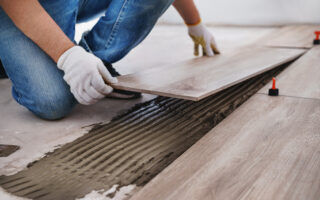
Laying tiles concept. Tiler, spatula and glue when laying tiles with close up hands. Pull tabs and wedges for leveling system.
When you’re thinking about air quality inside of your home, one of the many things that you have to watch out for is vinyl flooring. These types of flooring materials are often very durable, and easy to clean, – they look good, and they can be a great option for renovating a space. But they can also give off harmful chemicals called volatile organic compounds or VOCs. These can lead to health risks.
That’s something to think about when you’re installing this kind of material in your home, or when you’re buying a house with vinyl flooring recently installed.
Vinyl Flooring and VOCs
First of all, volatile organic chemicals, or VOCs, are potentially harmful chemicals that are in a lot of building materials, including flooring, paint, wall coverings, and more.
The major class of VOCs to be aware of in vinyl flooring is dioxins, which contribute to certain kinds of cancers, and can also cause birth defects or compromise the human immune system.
Dioxins are categorized as persistent organic pollutants; that means they’re hard to get rid of when they’re in an indoor area.
Secondly, there are also phthalates that are in certain kinds of plastics. These are known to be endocrine disruptors. They can also cause respiratory conditions, hormone imbalances, and reproductive issues.
Where These Chemicals Come From, and How They Get Released
VOCs are added into building materials and consumer products during manufacturing. Over time, they can get released into the air as the product wears or breaks down. This includes both when the material is newly installed, and later, as it ages. This process is referred to as off-gassing.
In many cases, you’ll smell the pollution in the air. The chemicals are often tied to fumes which have an obnoxious chemical odor. But in some other cases, you may not be aware of the extent to which you’re breathing these harmful chemicals, because some VOCs are odorless.
So often, we hear from people who just didn’t know that these substances were present in their indoor air at all. They’re not visible! There’s really no way to know about this unless you seek out the information for yourself. That’s part of the challenge. Use an air monitor to see what’s lurking in your indoor air.
Avoiding VOCs in Your Home
So let’s talk about ways that you can reduce or eliminate your chances of being affected by these harmful chemicals.
The first and simplest one is to always research a project before starting some renovation or improving your indoor space in some way.
You may find that although a given project might look good when it’s installed, it won’t be good for your health, so you have to weigh that when you make your decision. But to know that, you have to research what’s in the material.
Choosing Wellness
Another option for being safer is to deliberately source materials that don’t have the VOCs in them, or those that are low in VOCs.
These days, you have a lot of choices in commercially available non-VOC or low-VOC paint, for example.
It used to be that VOCs were more tolerated in the manufacturing of interior house paint, but the public outcry led manufacturers to treat things a little differently.
The same is true for other products like vinyl flooring. You might have ecologically sustainable products like bamboo that don’t have certain chemicals in them. By reading the labels and doing your research, you can make an informed decision that is best for you, and safest.
A third option is running air purifiers to reduce the harmful VOCs as they are off-gassed. That’s helpful if someone else already installed these materials in your home.
Using an Air Purifier
You can mitigate the potential damage to your health by running these machines consistently and scrubbing VOCs out of the air. You’re going to want to have activated carbon in your machine, in order to trap those dangerous VOCs and get them out of your airflow. A bigger carbon bed can really do wonders for your air quality. Ideally, you will want to run the unit on medium instead of high to increase the dwell time the contaminants are in the unit all while staying faster than the source.
We hear from hundreds of homeowners who were saved from inhaling more significant amounts of these VOCs by researching certain vinyl flooring products, and VOCs.
USAirPurifiers is a family and veteran-owned U.S. business offering high-quality air purification solutions. The Lulay Team knows that clean air isn’t one-size-fits-all, so we match the right solution to your needs and budget. Invest in your family’s health and breathe easier. Your health is truly our top priority because everyone deserves to enjoy clean air everywhere!