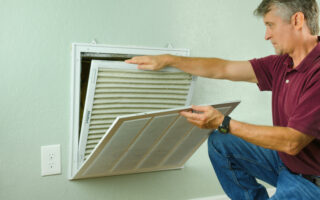
Professional repair service man or diy home owner removing a dirty air filter on a house air conditioner so he can replace it with a new clean one.
Sometimes all of this filter language just sounds like jargon. For example, what is the difference between a MERV 13 and a HEPA filter?
To really understand some of these designations, you have to think about the difference between different kinds of home systems. That can make a big difference in what you choose for your home, and the ultimate result.
Three Big Differences
The most fundamental difference between MERV 13 and HEPA is that one, HEPA, is primarily used in air purifiers, and the other one, MERV 13, is used as an inline in HVAC systems like furnaces or air conditioning units.
So this means that both of these designations are used in a totally different context, and you can think about them in different capacities.
The second difference is this – you typically don’t think about your HVAC system, your furnace or heater or air conditioner, as something that purifies the indoor air in your home. You might think of that filter as providing some cleanliness for a system that moves the air around significantly, but you wouldn’t see it as primarily an air purification system. At least, most people would not.
With air purifiers using HEPA filters, that’s exactly what they are. They don’t heat or cool – they are there to purify the indoor air, removing particles down to a range of .1 to .3 microns, depending on the HEPA filter in question.
So that’s a major difference.
More on HEPA and HVAC
The third difference is this – although you have whole home air purification systems, many of the actual air purifier units are most functional at point of use. That means, they clean a specific area of the home or building, and placement is important.
With the MERV 13 systems in the HVAC systems, it’s a whole house or whole building system. You may have split units for multiple dwelling spaces in a building, but you often have a vent or radiator system that goes all over and serves the entire interior, and placement isn’t a concern because these systems are already fixtures in the home.
For example, you have your intake and your outtake clearly built within the building, and the filter is in a particular place. You can’t move it.
With an air purifier, you can put it wherever you want to, since it’s not part of a fixed ductwork system. You have to think about locating that air purifier strategically, according to where your contaminants are coming from, and what you’re experiencing in terms of mold, allergens, volatile organic compounds, harsh chemicals or anything else.
Scientific Specs: What These Filters Do
For a different approach, you can think about MERV 13 and HEPA in terms of actual particle sizes that each one traps.
A MERV 13 filter will often catch particles from one to 3 microns or larger, where the measurement is in terms of whole microns.
The HEPA filter, by comparison, traps 99.97% of particles down to .3 microns, or 3/10 of a micron, and that’s an entirely different scale.
So that alone shows you why you wouldn’t use a MERV 13 filter to throughly purify the air inside of your home. That’s not really its intended use, either. During COVID, there was an effort to outfit whole buildings with systems. That was in conjunction with physical cleaning of surfaces. But that still doesn’t mean that conventional building systems are going to scrub small particles from the air.
The Maintenance Piece
What these filters have in common is that you can use them without a great deal of labor-intensive maintenance. Most furnace filters and air-conditioning filters need to be replaced monthly, quarterly or annually. An air purifier filter needs to be replaced when the filter is entirely worn out, or the activated carbon is saturated.
Some models, like an IDEAL Pro, will tell you when the filter needs to be replaced.
Here’s another thing that HVAC systems and air purifiers have in common. Too often, whoever purchased them or is using them just doesn’t think about replacing the filter on time. They continue to use worn-out filters and saturated active carbon, decreasing the effectiveness of their system over time.
In other words, maintenance is a must, and staying on top of it will dramatically improve the efficiency of the purifier, and therefore, improve the results.
So again, although your HVAC system helps you stay cool in the summer and toasty in the winter, your air purifier does something different. It traps very small particles responsible for all kinds of potential health conditions, like respiratory problems and allergies. It helps with:
- Mold spores
- Pet dander
- Dust mite debris
- Small dust particles
- Chemicals like formaldehyde and benzene
And it does all of this with a state of the art filtration system that you can rely on.
USAirPurifiers is a family and veteran-owned U.S. business offering a wide range of high-quality air purifiers, scrubbers, filters, air monitors and humidifiers. The Lulay Team knows that clean air isn’t one-size-fits-all, so we match the right solution to your needs and budget. Invest in your family’s health and breathe easier. Your health is truly our top priority because everyone deserves to enjoy clean air everywhere!