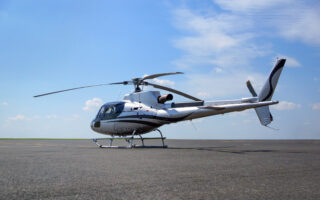
Executive light class helicopter shot on the airport apron. Nice wather. Summer blue sky.
There are a lot of eyes in the sky over the Big Apple every day, and that’s causing some controversy as public planners work to decrease air pollution and noise in the city.
Current estimates suggest that there are about 30,000 tourist flights over the city each year, including those coming from nearby New Jersey take-off points.
Experts estimate commuters take around 10,000 to 20,000 per year, and public response trips are estimated to be another 10,000 a year.
The part that has people concerned is the tourist flights or other ‘non-essential’ trips.
“A significant reduction in or ban of nonessential helicopter flights in the NYC area would greatly reduce helicopter noise and pollution issues,” write representatives of a group called Stop the Chop, aimed at limiting helicopter traffic in NYC.
Essential and Non-essential Flights
Stop the Chop characterizes ‘essential’ flights as helicopter operations for the military, emergency services and police and medical responses, as well as government work and the use of helicopters in the news and media industry.
Non-essential helicopter trips are tourist trips, commuter trips, chartered or corporate trips, and trips by non-professional photographers or other similar ride-alongs. There’s a triangulation that takes into account the purpose of each trip, along with the collective impact.
The Money Angle
Others suggest that New York City needs its helicopter traffic to drive revenue for the city.
The New York City Economic Development Corporation which manages the Downtown Manhattan Heliport says that helicopter tourism contributes $50 million to the city’s budget per year.
Mayor Eric Adams has gone on record to support the status quo on helicopter flights.
“That is part of the attraction of businesses being in the city, people coming to the city, seeing the city from the air,” Adams said. “As part of the attraction, what we must do is make sure it’s safe, make sure it is done correctly.”
Fatal Crashes
Then there’s the issue of safety, where a company called FlyNYON paid part of a settlement for $90 million after a man died in a helicopter crash in the east river in 2018. After that, officials banned open-door helicopter flights over the city.
But although there is personal risk to taking one of these rides, it’s the communal aspect of helicopter traffic that has Stop the Chop and others concerned.
Air Quality in Your Community
People are trying to keep the air cleaner in the places where they live. New science is showing exactly how small air pollutants and microparticles are harming human health.
Specifically, tiny particles from all types of combustion can get embedded deep in the lungs, triggering:
Asthma and allergies
Respiratory chronic disease
Symptoms like coughing and sneezing
With that in mind, many people in public planning are paying attention to air pollution and its effects. (In New York, try an Airpura 700 or 714 for small spaces like an apartment.)
Your Indoor Air
If you’re in New York City or anywhere else, you may be concerned about the levels of smog and air pollutants in your urban environment.
But many of us also have potentially harmful air contaminants in our homes.
Some of it comes in from outside in the form of small particles termed PM 2.5 by experts, or items like nitrogen dioxide from vehicle exhaust.
Then you have your range of industrial pollutants like fine soot and traces of heavy metals.
But there are also natural contaminants from indoors, such as mold or dust mite particles.
There is also the range of chemicals that come from manufactured items like formaldehyde, benzene, and TCE.
These are often called volatile organic compounds or VOCs. Look for them in all kinds of building materials and household items.
Checking the Air
How do you know what’s in your indoor air?
It’s relatively easy to buy an air monitor and set it up in a particular part of your home.
Get a detailed report on what’s lurking in your indoor air, and then you can make a plan to remove those elements and get cleaner, more breathable air every day.
Modern Air Purifier Machines
Today’s air purifier machines reduce a wide range of air pollutants using specific new technologies that are ultimately very effective on both organic and chemical compounds.
There’s a HEPA filter, which is especially effective in removing small particles. A medical grade HEPA will cover 99.97% of particles down to .3 microns, and a superHEPA or microHEPA will remove 99.99% down to .1 microns.
Then there’s activated carbon, where the small pores in the material trap certain kinds of particles and remove them from the airstream.
These are good things to know when you’re looking at buying an air purifier. A lot has gone into the design of these modern appliances. It’s not just ventilation, or a fan, or a source of white noise.
Special Considerations
When shopping for an air purifier, you want to figure out what the actual performance of one of these systems is over time. You can use a metric called air changes per hour to show how much air is cycled by a particular machine in a size of room or space.
You can also look for special features like whisper-quiet operation, or settings you can change throughout the day or night.
In addition, there are other new technologies like machines that will add helpful probiotics to your indoor space, or machines that will heat treat contaminants, or use UV light on them.
Take a look, and let US Air Purifiers LLC help you to choose the design that’s right for you.
The Lulay Team at USAirPurifiers is a family and veteran owned U.S. business, and we are truly here to help with your best interest in mind. Our team will help you to cleanse your indoor air, and get a better result with modern technology that fights air pollution where it lives – and where you live, too! Make an investment in your health and the health of your family, to breathe easier all day and all night.