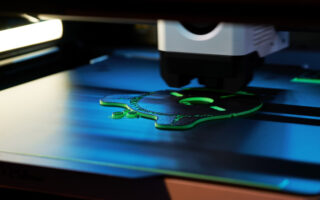
A 3D printer operates efficiently, layering vibrant green filament to form an intricate object. The workspace is illuminated by soft overhead light, highlighting the technology.
3D printing can be a lot of fun. It can even be a great side hustle, something to supplement your income in tough times.
But if you don’t know how to protect your health while churning out your designs, this could be a health risk.
It’s important to know up-front about what these machines do, how they operate, and how they may emit ultrafine particles, harmful chemicals and toxins as they work.
We’re going to write this in a listicle format, to show some of the best solutions for managing these health risks – but there’s really one thing that you need to know.
That’s the reality: that these printers can emit things like formaldehyde and benzene used as they manufacture the designs that they’re programmed to turn out.
Chemicals in Your Home
Without some kind of mitigation, this kind of air pollution can become intense and be harmful to your health.
It’s not just a question of low-level incidental exposure to carcinogens and volatile chemicals, as well as ultrafine particles.
The plastics and materials used by the 3D printer will be off-gassing directly into your living space – so the bottom line is, it’s best to do these kinds of things outside. If you can’t, you can take advantage of some practical solutions to make these processes less risky. But if you don’t know about any of it before you set up and use your 3D printer, you may be in for an unpleasant surprise.
Time and time again, newbies set up their 3D printers, only to realize that their indoor air gets really bad. They may notice these intense smells that represent heavy off-gassing, or they might not notice any unappealing smells, but still suffer from headaches and respiratory problems.
If there are any pregnant women or children in the home, they may worry about this, too.
People aren’t ready for this kind of news sometimes, because they never realized that these machines will be so heavily impactful on their indoor spaces.
Bad News
“I just didn’t know it was going to be this bad,” one of our customers said, of the initial print run after unpacking the machine and setting it up. “I just got scared – what am I breathing in?”
Indeed, there’s a lot going on when you let one of these machines “loose” in your home – part of that elevated risk is a lack of ventilation – in modern buildings, the air is often sealed in to conserve heating and cooling costs.
But part of it just has to do with the ways that the manufacturers make 3D printers. They don’t make them primarily for safety, not completely – so you have to take precautionary measures at home, to make sure you’re safe.
With that in mind, let’s go over four practical implementations to help protect your health if you’re 3D printing in your house.
Protective Masks
We know that protective masks work against things like dust, and even fiberglass and other nasties, in industrial environments. They can be effective against these types of harmful chemicals thrown off by 3D printers, too. So if you absolutely have to print in an enclosed space, your mask can help out quite a lot. However, you’re still generating a lot of these chemicals, and secondhand exposure can still be dangerous.
Ventilation
If you can ventilate the area while you’re printing, so much the better.
The science around ventilation is sort of like the science around air purifiers. It has to do with where air goes, how it moves, and how to mitigate health risks. In the case of ventilation, you simply have the air moving to an outside place where you’re not breathing it. With an air purifier, you can strategically place the machine to intercept contaminants and cleanse the air before it gets to you. The principle is mostly the same.
You can also choose to print in completely closed off areas separate from your living space, like a garage or some other area that has ventilation to the outside.
This will largely solve the problem.
Air Purifiers
If you’re in these scenarios, you can introduce the power of the air purifier – a modern contraption, which can specifically purify your indoor air of contaminants and harmful toxins.
Modern air purifiers with high-grade HEPA filters can take care of a lot of different kinds of potentially harmful particles – they can help with mold, with allergens, with small particles called PM 2.5 that are admitted by burning wood or fossil fuels. They can cut down on volatile organic compounds like formaldehyde, especially in conjunction with activated carbon. They can reduce dust mite particles.
The list goes on.
So air purifiers can be tremendously effective in reducing your health risks if you are 3D printing in your home.
As for air changes, For fused deposition modeling (FDM) printing with standard filaments (like PLA) in a normal room, you’ll often want at least 4–6 ACH. For resin printing or printing more hazardous / high-VOC materials: aim for 6–10 ACH, especially if you don’t have a dedicated exhaust system. If you have multiple printers, especially in a “print farm” or makerspace, lean toward 6+ ACH, with dedicated exhaust or filtration (HEPA + carbon or fume extractor).
Consider a unit like the Airpura 700 for some of these uses, or other capable workhorses from brands like Ideal and Airfree.
Tents and Enclosures
Another common solution is a tent or enclosure in the space where you’re printing. This keeps the contaminant in a smaller enclosed space.
We’ve seen a lot of amateurs and DIYers using enclosures to help decrease the amount of formaldehyde or anything else that they’re breathing when the 3D printer off-gases.
In many cases, it’s a partial solution – it cuts down on the contamination, but some still seep into the indoor space. Which brings us to a very relevant point – when you combine two or more of these interventions, you get a lot safer! For example, a tent might help, but where does the air in the tent go? It has to vent outside. Regardless, most of our clients still use a machine to ensure they are safe.
Ideally, you don’t have to be 3D printing inside of an enclosed, unventilated space. But you can use these other interventions to help with the threat to your health.
Some of these tents and enclosures are good for other uses. For example, we’ve seen people use tents that were made for indoor gardening as 3D printer enclosures.
Or you may find a tent that engineers designed specifically for this purpose.
Clean the Air
Either way, as mentioned, it’s a partial solution to the problem of contamination spreading around in your indoor air.
That’s a survey of some of the best ways to cut down on health risks when 3D printing indoors. But the bottom line, again, is that it’s important to know these things before you start your first project.
File it under ‘things other people won’t tell you,’ and remember that so many of the air pollutants that can impact our health are invisible, odorless, and not really observable in our environments. We might not even know that they’re there. Or we might smell them, and not know what that nasty smell is, and what the particles are doing to our bodies.
Anyway, it’s always good to do your research before buying an air purifier.
The Lulay Team at USAirPurifiers is a family and veteran owned U.S. business, and we are truly here to help with your best interest in mind. Our team will help you to cleanse your indoor air, and get a better result with modern technology that fights air pollution where it lives – and where you live, too! Make an investment in your health and the health of your family, to breathe easier all day and all night.