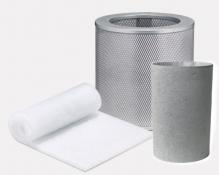
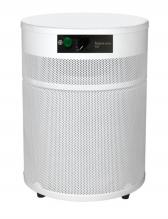
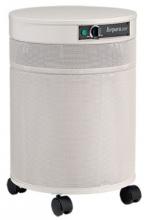
The Airpura F400DLX air purifier covers up to 1,000 sq ft (depending on model and speed) and traps formaldehyde, airborne chemicals, and VOCs with its extra large bed of enhanced, impregnated activated carbon, as well as particles (1 micron and larger) with its HEPA Barrier filter. It’s a super enhanced chemical abatement unit. Some of the prime chemicals it filters, which can cause moderate to severe health issues like headaches, drowsiness, and rhinitis, are formaldehyde, acid gases, VOCs and much more.
Featuring: est. 12 lbs of impregnated carbon along with a HEPA Barrier (not a medical grade HEPA).
*Please note: This filter combination is NOT recommended for people with severe MCS.
If you loved the larger F700DLX, then you will love the newer F400DLX model designed for smaller spaces.
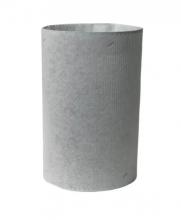
The Airpura F400DLX is the heavy-duty formaldehyde unit in Airpura’s compact 400 series. Inside, an est. 12 lbs of carbon, a blend of carbon impregnated with potassium permanganate and coconut shell carbon, works to reduce formaldehyde, acid gases and other VOCs, while a HEPA Barrier catches particles 1 micron and larger. It’s designed for heavy formaldehyde and similar VOCs rather than ultrafine particles, and on high it reaches about 2 air changes per hour (ACH) in up to 1,000 sq. ft.
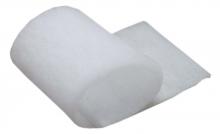
The F400DLX comes with a standard polyester pre-filter. An organic cotton pre-filter is available at no additional cost: just note it in the comment field when you order, and we’ll be happy to configure your unit for your needs.
Formaldehyde is a tiny, light molecule, and standard activated carbon has trouble holding it. Potassium permanganate reacts with formaldehyde and other light gases, so the F-series carbon can handle chemicals that a standard carbon bed may let slip through. Formaldehyde off-gasses from pressed wood, new furniture, cabinetry, flooring, carpet and finishes, and along with acid gases and other VOCs, it can contribute to moderate to severe health issues like headaches, drowsiness and rhinitis.
The F400DLX offers the same quality and compact housing as the Airpura F400 & F414, but it adds carbon for formaldehyde, acid gases and VOCs, an est. 12 lbs versus an est. 8 lbs. To make room for the larger carbon bed, it uses a HEPA Barrier (95% at 1 micron) in place of the F400’s True HEPA or the F414’s H14 SuperHEPA. Pick the F400DLX for heavy formaldehyde; if you also need to catch very fine particles, the F400 or F414 is the better match.
This filter combination is not recommended for people with severe MCS (Multiple Chemical Sensitivities), or for anyone sensitive to potassium permanganate. Ask us, and we’ll walk you through the options.
After the heavy formaldehyde problem is under control, the special chemical filter can be swapped for a conventional particle and chemical filter combination. Contact us, and we’ll help you choose the right filters.
Running on high, the F400DLX moves about 2 air changes per hour through 1,000 sq. ft. with 8-foot ceilings. There’s no single right number of air changes; it depends on how much formaldehyde or VOC is present, how fast it builds up, the level of filtration you’re after and your sensitivities. As rules of thumb go, allergy and asthma clients often want 3–7 ACH, while heavy VOC or smoke areas may even call for 10–12 ACH. Whatever you choose, the unit should outpace the source, cleaning the air faster than chemicals are released.
If a small room calls for high air changes, use two 400-series units or a 600 model rather than one 700-series unit, which can draw its own clean air back in. Our Air Changes per Hour Calculator is a good place to start, or contact us by email for help. For larger spaces, the Airpura F700DLX brings the same DLX approach to a bigger unit.
The slower the fan, the longer the air stays in the impregnated carbon. Although low speed gives the carbon the most dwell time with formaldehyde and other VOCs, high speed gives the most air changes per hour. Determining which matters more depends on the situation. For formaldehyde, VOCs, odors, gases and chemicals, slower speeds are preferred, for the longest dwell time possible; for particles, more air changes are usually better. The speed you need also depends on how much formaldehyde is present and how fast it’s being released. We still recommend running the F400DLX at least slightly faster than the source, and as slowly as it can go while it stays ahead, which is usually medium or low. Often, medium is the sweet spot: it strikes a balance between air changes and dwell time. To target formaldehyde and other VOCs, size the F400DLX on medium speed, leaving room to go higher if more formaldehyde is released.
Choosing an Airpura? Our Airpura Buyer’s Guide tab explains what sets Airpura apart, how to read the model names and how the carbon canisters and filters fit together.
| Filter | Service Interval |
|---|---|
| Pre-filter | Check every 3–6 months; change every 6–12 months. If you vacuum it, vacuum lightly, since a strong vacuum can pull out the fibers. |
| Impregnated carbon | Up to 2 years, depending on usage and contaminants |
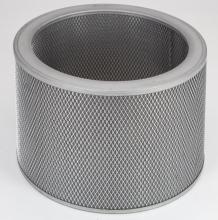
| HEPA Barrier | Typically every 12 months (some clients go 18–24 months), depending on usage |
| UV lamp | N/A (not used on DLX models) |
Note: Filter maintenance is based on standard usage and average contaminants. Depending on your situation, filters may need to be changed more or less often.
Made for heavier formaldehyde, acid gases and VOCs in smaller spaces, the Airpura F400DLX holds an est. 12 lbs of potassium permanganate impregnated carbon and a HEPA Barrier in Airpura’s compact 400-series cabinet.
No two spaces are alike, and heavy VOC or smoke areas may even call for 10–12 ACH. For formaldehyde, base your sizing on medium speed. See our Air Changes per Hour Calculator, or contact us by email for sizing help.
Free Shipping
Airpura F400DLX Filter Bundle: 400 Prefilter, F-DLX Carbon, HEPA Barrier with Frame
Free Shipping
Airpura 400 Prefilter -2 pack: FITS 400 Series
Free Shipping
Airpura Carbon Filter F400DLX Carbon Blend for Formaldehyde
Free Shipping
Airpura HEPA Barrier Filter Fits C400 C40DLX T400 T400DLX G400DLX F400DLX S400DLX with Frame
Free Shipping
Airpura F400 & F414 Air Purifier: Formaldehyde, VOCs and Particles
Free Shipping
Airpura F700DLX Air Purifier: Heavy Formaldehyde, Larger Spaces
Free Shipping
Airpura C400DLX Air Purifier: VOCs, Chemicals & Gases
Free Shipping
Airpura P700 PLUS & P714 PLUS Air Purifier: TiO2 HEPA for Large Rooms
If the F700DLX is too large for your space, the F400DLX is an excellent option.
Ideal for smaller spaces with:
Not ideal for:
These are just some of the uses for this unit. Many contaminants are a good fit for more than one unit, so if you’d like help finding the best one for your needs, please contact us.
Many factors come into play when choosing an air purifier, including the contaminants, coverage (enough air changes for the level of off-gassing), how quickly things are off-gassing, particulate matter, and your own sensitivities. The uses above are suggestions. Air purification isn’t a black-and-white science, and things outside our control, like humidity or where the unit is placed, affect results. We wish there were one unit for every need, but there are always trade-offs, like sound versus power and budget versus filtration.
Don’t hesitate to ask, especially if your contaminant levels are high.
Airpura air purifiers are built differently from many units on the market, with a focus on clean construction, deep filtration you can customize, and long-term durability. This guide covers what sets Airpura apart, how to read Airpura model names and how the carbon canisters and filters fit together, so you can choose the right unit or change it later.
Every Airpura model name tells you what’s inside. The S614, for example, has SuperGas carbon (S), the 6-series motor (6) and an H14 SuperHEPA (14).
| Filter | Service Interval |
|---|---|
| Standard pre-filter | Typically every 6–12 months, depending on use. If you vacuum it, vacuum lightly, since a strong vacuum can pull out the fibers. |
| TarBarrier pre-filter | About monthly in public places; less often in homes, depending on how much smoking takes place |
| Carbon filter | Up to 2 years, depending on usage and contaminants |
| HEPA-Barrier | Every time the TarBarrier is changed in public places; typically every 12 months in homes |
| HEPA or SuperHEPA | 2–5 years max, depending on usage and contaminants |
| UV lamp | Not applicable |
Note: Filter maintenance is based on standard usage and average contaminants. Depending on your situation, filters may need to be changed more or less often.